
 Engleză
 中文简体
中文简体 Русский
 Español
 Português
 Türkçe
 العربية
 Deutsch
 Polski
 Italiano
 Français
 한국어
한국어 ไทย
ไทย Tiếng Việt
 日本語
日本語












Surse de lumină standard și lămpi auxiliare
Manual de utilizare
Aplicabil LISUN models: RLS-100W、RLS-50W、SLS-100W、SLS-100WIR、SLS-10W,SLS-10WIR、SLS-50W,SLS-50WIR
1. Diferențierea modelului
1.1 Standard Light Source Models
| Model/Aplicație | Calibratable Integrating Sphere Sizes | Calibratable wavelength range |
| SLS-10W | 0.3 m/0.5 m | 350-800 nm |
| SLS-10WIR | 350-1050 nm | |
| SLS-50W | 1m / 1.5m / 1.75m | 350-800 nm |
| SLS-50WIR | 350-1050 nm | |
| SLS-100W | 2m / 2.5m / 3m | 350-800 nm |
| SLS-100WIR | 350-1050 nm |
1.2 Auxiliary Lamp Models
| Model/Aplicație | Applicable Integrating Sphere Sizes | Applicable Wavelength Range |
| RLS-50W | 1m / 1.5m / 1.75m | 350-1050 nm |
| RLS-100W | 2m / 2.5m / 3m |
2. Colectare de date
2.1 Data Labels
Standard Light Sources and Auxiliary Lamps each have a label with the corresponding light source data affixed to their packaging, as shown in Figure 2-1.
| Număr | notițe |
| ① | Light Source Name, Model Number |
| ② | Light source data. Standard Light Sources include: reference voltage (higher than the actual voltage), rated current, color temperature, luminous flux, and color coordinates; Auxiliary Lamps include: reference voltage (higher than the actual voltage) and rated current. |
| ③ | Light Source Serial Number |
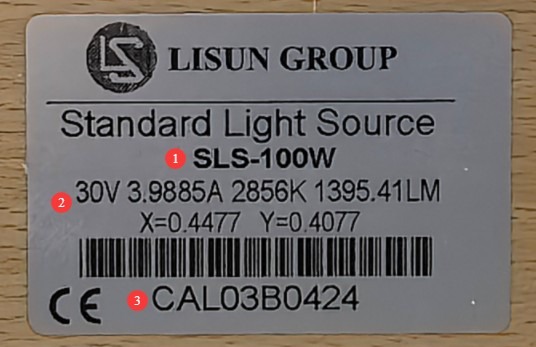
Figura 2-1
Certificat de calibrare 2.2
2.2.1 File Downloads
We have already sent the download links for important documents, such as the Standard Light Source calibration certificates, via email at the time of shipment. Please download them promptly. If you missed the email, you may also contact us directly to request the download links again.
2.2.2 Introduction to Calibration Certificates
Take the calibration certificate issued by LISUN as an example; see Figure 2-2.
| Număr | notițe |
| ① | Light Source Name, Model, Serial Number |
| ② | Light source data. Standard Light Sources include: reference voltage (higher than the actual voltage), rated current, color temperature, luminous flux, and color coordinates; Auxiliary Lamps include: reference voltage (higher than the actual voltage) and rated current. |
| ③ | Shelf life: The shelf life of the light source is 12 months. |
| ④ | Data calibrării |
| ⑤ | Calibration Environment: The operating environment should be as consistent as possible with the calibration environment to avoid errors caused by environmental factors. |
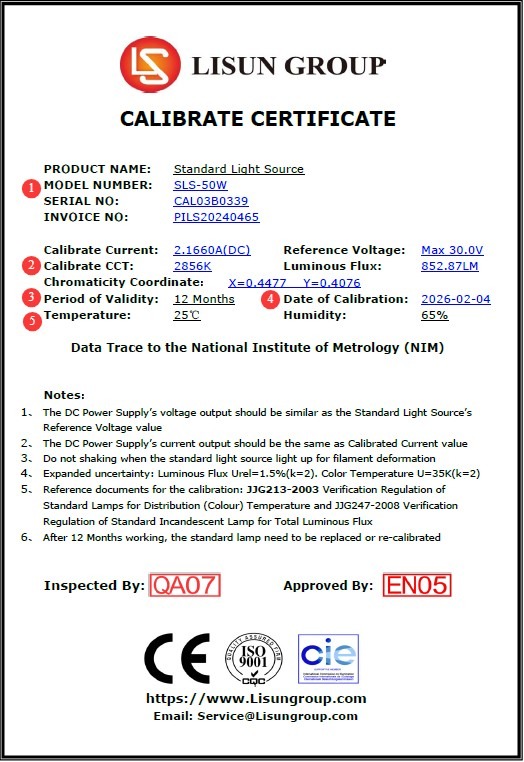
Figura 2-2
3. Note importante
3.1 Inspecție vizuală
When unpacking the equipment, handle it gently and avoid vigorous shaking to prevent the filament from breaking. After unpacking, first check that the Standard Light Source is intact, that the filament is not broken, and that the pins are in good condition. If you notice any issues, please contact us immediately.
3.2 Validity Period Management
All light sources have a 12-month shelf life. In practice, this period is calculated from the date of first use. After 12 months, please purchase a new light source to ensure the accuracy of calibration and testing.
3.3 Data Consistency
Each light source head is marked with its serial number, as shown in Figure 3-1.
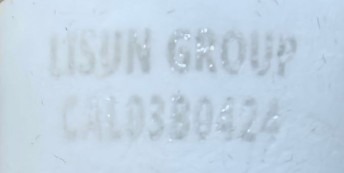
Figura 3-1
The light source serial number is also printed on the data label (see 2.1) and the calibration certificate (see 2.2.2). The data for each light source has been calibrated and is unique; be sure to verify that the serial numbers match before use.
4. Use of Light Sources
4.1 Principles for Retrieval and Storage
White, lint-free, dust-free cleanroom gloves must be worn when handling the device; do not touch any part of the light source with bare hands. Handle the device gently to avoid bumping or bending the pins.
4.2 Light Source Installation
4.2.1 RLS-50W/RLS-100W/SLS-10W/SLS-10WIR
Carefully remove the light bulb from the lamp holder, then simply install it in the designated location, as shown in Figure 4-1.
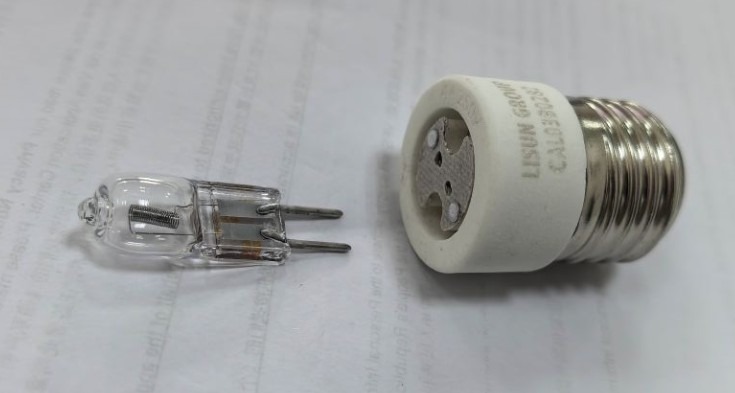
Figura 4-1
4.2.2 Installation of Other Light Sources
Install directly into the E27 light socket at the specified location.
4.3 Turning on the Light Source
4.3.1 Lighting Requirements
All light sources are constant-current DC-powered. The current values listed in their specifications are the rated current, and the voltage values are the reference voltage. Once the light source is turned on, your DC power supply should indicate a constant current, and the displayed current should match the light source’s rated current; the displayed voltage should be close to but not exactly the same as the light source’s reference voltage—this is normal.
Note: Do not operate the light source at a current exceeding its rated value, as this will shorten its lifespan and may even cause damage; do not use an AC power source to power the light source, as this will immediately burn out the filament.
4.3.2 Specificații de alimentare
The “10/50/100” in the light source model numbers are merely reference power values used to distinguish between models; they do not represent the actual, precise power. Once the light source is turned on, refer to Section 3.2.1 to verify that its actual current matches the rated current; the voltage and power values are for reference only.
4.3.3 Gestionarea excepțiilor
Several Common Issues with Light Source Illumination.
| Fenomen | Cauze și soluții posibile |
| Nu va porni | Check the DC power connections; check the light source connections and whether the filament is broken |
| Not lit with constant current | The DC power supply offers both constant-current and constant-voltage output modes. Select the constant-current mode, enter the rated current of the light source, and enter a higher reference voltage value. The reference voltage must be higher than the actual voltage; otherwise, constant-current output will not be possible. |
| Constant current is on, but the voltage is abnormal | The actual voltage for a 10W light source is approximately 7V, while that for 50W and 100W light sources is approximately 24V. If the actual voltage is too low (e.g., only about 1V), treat it as a “failure to illuminate” issue. |
4.4 Precautions After Using the Light Source
4.4.1 Auxiliary Lamp
After using the Auxiliary Lamp, it can remain in the Auxiliary Lamp holder inside the Integrating Sphere. Simply turn it on when needed and turn it off when not in use.
4.4.2 Standard Light Source
A Standard Light Source bulb is still hot immediately after use. Please wait until it has cooled to room temperature before carefully placing it back in its packaging. Do not allow any object to come into contact with the bulb while it is still hot, as contamination of the bulb will directly affect the accuracy of the measurements.
5. Storage and Maintenance of Light Sources
Storage Conditions: Dry, clean, vibration-free environment with a temperature of 10°C to 30°C and relative humidity ≤ 65% RH; keep away from corrosive gases. Storage Requirements: After cooling, place the product in its original packaging; do not store it haphazardly.
The light source is a consumable item that must be replaced when it reaches the end of its service life; it must not be used beyond that point.